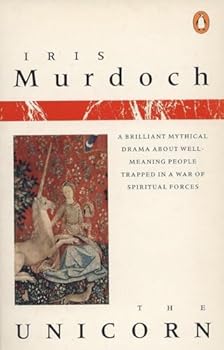
I should warn you in advance, there are no actual unicorns in this book. Disappointing, I know, but the title was what originally caught my attention. I could tell from the back cover copy that there wouldn’t be any real unicorns but I was curious just what about it was “unicornesque” enough to qualify for that title.
When I picked it up off the shelf, I thought this was some totally obscure novel, but I soon learned that author Iris Murdoch is a well-known 20th Century writer who published something like thirty novels during her long career. This is something that fascinates me about prose fiction: There’s always so much material you’re not aware of even if you’re a relatively “well-read” person. I guess that’s true with a lot of media and prose fiction really isn’t particularly special in this regard, but when I have this kind of experience, it’s almost always with this medium.
Anyway, the Unicorn in this case refers to Hannah, a vivacious young woman who lives in a country estate called Gaze Castle. At first it seems that Hannah is a widow, but as we learn more about her, we eventually learn that after she tried to kill her husband by pushing him off a cliff (!) he imprisoned her at Gaze and she cannot leave. When other characters find out about Hannah’s prisoner status, they try to help, with disastrous results.
The unicorn symbolism refers to Hannah, who is a kind of pure creature that the other characters project onto. Marian, a teacher who is drafted to be Hannah’s daily companion, sees her as a captive princess who needs rescuing. Effingham Cooper, a middle-aged man who has a long-standing relationship with Hannah’s elderly neighbor, sees Hannah as a kind of pure, virginal beauty that he can put on a sky-high pedestal and worship.
Sometimes I’m tickled by how simple the plots in these kind of highbrow novels are. “A young woman is trapped in a house and people project all their shit onto her” doesn’t sound like it would have that many places to go, but Murdoch manages it.
Of course, this whole idea that Hannah is “pure” is nonsense. She had an affair with a neighbor, leading to the whole unfortunate “tried to push husband off cliff” episode, and she is manipulating everyone around her in different ways. Meanwhile, her absent husband is gay (possibly bi) and left his lover to be his wife’s jailor. Also meanwhile, Effingham goes for a walk once and nearly drowns in quicksand, and everyone acts like this is perfectly normal. It’s a bit of a weird book.
What I really enjoyed was Murdoch’s descriptions of people and locations. It took awhile for me to acclimate to her style, but her detailed setting work paints vivid pictures in the mind. I’m always impressed with authors who can describe different kinds of settings without sounding like they’re just reading off a laundry list of details, and Murdoch is really good at this. It’s also an interesting character study in which our unicorn, Hannah, is arguably the least interesting character. But it is Hannah’s wretched situation that pulls the other characters out of their conformity and takes them to places they never thought they would go.
It’s also a gothic novel that takes place in mid 20th-century, which is interesting; when I think of gothic novels I think of the 1800s, so it’s unusual to read one where people are driving cars. It feels timeless though; other than the fact that people drive cars instead of ride carriages, it feels like a classic gothic novel.
I don’t know if I’d recommend this book to the average reader; it’s wordy (though not terribly long), and it’s weird, and the characters seem to often be suffering from a kind of temporary insanity. If you’re the kind of reader who enjoys Proust or George Eliot, maybe see if you can hunt down a copy of this.
 Karen L. Mead
Leave a comment